Uniform Store Marketing: A Free Guide + Planner to Get Results
09/09/2026
Uniform store marketing can quickly become overwhelming when you are also trying to run a business. Your website needs attention. Social media needs content. Customers need to find you on Google. Reviews matter. Digital advertising could help you reach new audiences. Meanwhile, you still have a store to operate and customers to serve.
The challenge is not finding marketing tactics to try. There are plenty of those.
The harder part is knowing which marketing efforts deserve your attention, how they should work together, and where your business should focus first.
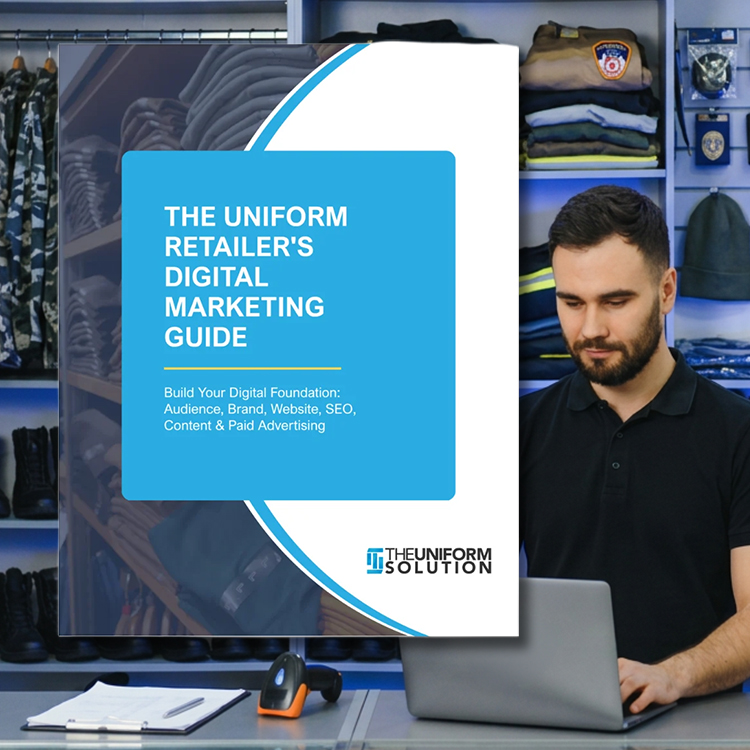
That is why The Uniform Solution created The Uniform Retailer's Digital Marketing Guide, along with a companion Digital Marketing Planner in Word and Excel formats. These free resources provide a practical framework to help uniform retailers evaluate their marketing, identify opportunities, and turn their ideas into an actionable plan.
Why Uniform Store Marketing Is Different
There is no shortage of marketing advice available to business owners. However, uniform retail has some unique characteristics that make a one-size-fits-all marketing strategy difficult.
Consider the audiences your business may serve.
You might sell scrubs to healthcare professionals, uniforms to nursing students, workwear to local businesses, or public safety uniforms to police and fire departments. You may also manage group or contract business for organizations with dozens or hundreds of employees.
Even within the same store, those customers can have very different needs.
An individual shopper may care about fit, comfort, selection, and convenience. A nursing student may need to meet specific program requirements before a deadline. An employer may be more interested in consistency, customization, ordering processes, and managing uniforms across an entire workforce.
Your sales channels can be just as varied.
Some customers may visit your physical store. Others may shop through your website or WebStore. Group customers may have a dedicated ordering process. You may also sell at mobile events or visit organizations directly.
Effective uniform store marketing needs to account for those differences.
That does not mean you need a separate marketing strategy for every customer. Instead, you need a clear understanding of your priorities. Then, you can make smarter decisions about where to invest your time and marketing budget.
Marketing Should Solve a Business Problem
It is easy to start with a marketing channel.
"We should post more on social media."
"We should run Google Ads."
"We need to work on SEO."
"We should send more emails."
Those ideas may all have merit. However, the channel itself should not be the starting point.
Start with the business problem.
Perhaps potential customers do not know your store exists. Maybe customers visit your website but do not take the next step. Your WebStore may be available, but existing customers are not using it to reorder. You might want to grow a particular customer segment or generate more group business.
Each of those challenges could require a different marketing approach.
For example, a business struggling with local visibility may need to focus on its website and search presence before increasing its social posting. A retailer with strong local awareness but low online ordering may need to focus on promoting the convenience of its WebStore.
That is an important distinction.
Uniform business marketing should support a specific business goal. When you know the problem you are trying to solve, choosing the right marketing tactics becomes much easier.
A Free Marketing Guide Created for Uniform Retailers
We created The Uniform Retailer's Digital Marketing Guide to help take some of the guesswork out of that process.
This is not a generic small-business marketing guide with the word "uniform" added to the cover. The examples, questions, and planning exercises were developed around the realities of running and marketing a uniform retail business.
The guide organizes digital marketing into four manageable steps:
- Understand who you are marketing to
- Build a strong digital foundation
- Create useful content
- Use paid advertising strategically
These areas are connected.
Your audience should influence your website. Your customers' questions should influence your content. Your business goals should influence your advertising. Your website should give people somewhere useful to go after they find you through search, content, or an ad.
When those pieces support one another, marketing becomes much more intentional.
The guide helps you understand that framework. Then, the companion planner helps you apply it to your own business.
Step 1: Start With the Customers You Want to Reach
Good marketing starts with understanding your customer.
However, defining your audience as "people who need uniforms" does not provide enough direction to build an effective strategy.
Different customer groups have different needs, questions, priorities, and reasons for buying. They may also discover your business in different ways.
That is why the first step in the guide focuses on identifying the audiences that matter most to your business.
You will consider who you want to reach, what those customers need, what may trigger a purchase, and why they might choose your store over another option. More importantly, you will begin prioritizing.
Your business may serve many audiences, but you do not necessarily need to market to all of them at once. A clearer picture of your customers can help you decide which opportunities deserve attention now.
The companion planner gives you a place to capture those decisions and start developing profiles for your priority customers. That foundation will make the rest of your marketing easier to plan.
Step 2: Make Sure Your Digital Foundation Supports Your Goals
Once you know who you want to reach, the next question is simple: What will those customers find when they look for you?
Your digital presence can shape a customer's opinion of your business before that person calls, visits your store, or places an order.
That presence includes more than your website.
Your branding, online store, search visibility, business listings, reviews, website content, and other digital touchpoints all contribute to the experience.
The second step of the guide helps you evaluate that foundation.
Instead of simply asking whether your business has a website or appears on Google, you will consider whether those tools are actually helping customers find what they need and take the next step.
The guide also introduces important concepts such as search engine optimization (SEO) and answer engine optimization (AEO). You will learn why the language your customers use matters and how your digital presence can make your business easier to understand and discover.
This section is not about becoming a search expert. It is about recognizing where your digital foundation may be helping or hurting your marketing efforts.
Step 3: Give Customers a Reason to Pay Attention
Content is one of those marketing terms that can sound more complicated than it needs to be.
For a uniform retailer, content can simply mean useful information that helps your customers answer questions, understand their options, or make a decision.
That could include a blog article, social media post, video, FAQ, buying guide, customer story, product explanation, or email.
The challenge is often deciding what to create and finding the time to create it consistently. Step 3 of the guide introduces a more practical approach.
Instead of creating content simply because you feel like you should be posting, you will learn how to connect content to your customers and business priorities. The guide also shows how the questions you already hear from customers can become a valuable source of marketing ideas.
Then, the planner helps you organize those ideas.
You will have tools for building a content calendar and creating a customer question bank, so your next piece of content does not always have to start with a blank page.
Step 4: Make Paid Advertising More Intentional
Paid advertising can expand your reach beyond the people already finding your business organically. However, the goal should never be to run ads simply because other businesses are running them.
A successful campaign starts with knowing what you want to accomplish.
Are you trying to reach a particular type of customer? Promote an important product or service? Generate interest in a group program? Increase online orders? Support a seasonal opportunity?
Those goals should influence everything that follows.
The fourth step of the guide introduces the roles Google and Meta advertising can play in a broader uniform store marketing strategy. It also covers the decisions that should happen before you launch a campaign, along with the importance of measuring results.
The companion planner takes that process one step further by giving you a framework for planning a PPC campaign.
You can capture the goal, audience, offer, message, budget, and other important campaign decisions before you start spending money.
The Guide Explains It. The Planner Helps You Do It.
Reading about marketing can give you ideas. However, ideas alone do not create a strategy.
That is why we paired the Digital Marketing Guide with a practical planner.
When you request the free resource, you will receive all three items:
- The Uniform Retailer's Digital Marketing Guide
- The Digital Marketing Planner in Excel
- The Digital Marketing Planner in Word
The Word and Excel planners contain the same material. You simply choose the format you prefer.
As you read the guide, look for the BUILD YOUR PLAN callouts. Each one directs you to a corresponding section of the planner where you can apply what you just learned.
The exercises help you work through areas such as your ideal customers, keywords, content calendar, customer questions, paid advertising, and marketing priorities.
You do not need to complete the entire planner at once. In fact, the process may help you discover that only a few areas deserve immediate attention. That is a useful outcome.
A good marketing plan should help you prioritize, not create an even longer to-do list.
Connect Your Marketing Instead of Collecting Tactics
One of the biggest benefits of creating a plan is seeing how different parts of your marketing connect.
Imagine that your business wants to reach more nursing students.
That goal could influence the audience you prioritize, the information available on your website, the content you create, and the advertising you consider.
Now compare that with a goal of increasing repeat WebStore orders from existing customers.
You are still marketing a uniform business, but the strategy may look very different.
This is why starting with "we need to do more marketing" can lead businesses in the wrong direction. More is not necessarily better.
A better question is: What does our business need marketing to accomplish?
From there, you can evaluate whether your current marketing efforts support that goal.
You may discover gaps. You may also discover that you already have valuable marketing tools that are not being used to their full potential.
The guide and planner are designed to help you make those connections.
Build a Uniform Store Marketing Plan You Can Actually Use
A marketing plan does not need to be a complicated document that takes months to create. It needs to give your business direction.
You should understand the customers you want to reach, the goals you are trying to accomplish, and the marketing activities that support those goals.
You should also know what deserves attention first.
That could mean strengthening your website before paying to send more traffic to it. It could mean developing content around questions your customers ask every day. It could mean improving how you promote online ordering to customers who already know your business.
For another retailer, the priorities could be completely different. That is exactly the point!
Effective uniform store marketing should reflect your business rather than someone else's checklist.
The Digital Marketing Guide gives you a framework for evaluating those decisions. The planner gives you a place to turn them into next steps.
Together, they can help you move from scattered marketing activities toward a more connected strategy.
Get Your Free Uniform Store Marketing Guide + Planner
You do not need to become a marketing expert to make smarter marketing decisions.
You need a clear understanding of your customers, your goals, and the tools available to help you reach them.
The Uniform Retailer's Digital Marketing Guide was created to help you build that foundation.
When you request your free copy, you will also receive the Digital Marketing Planner in both Word and Excel formats. Choose the format that works best for you and use it alongside the guide to start building your plan.
Whether you are trying to attract new customers, strengthen your digital presence, improve your content, or make smarter advertising decisions, these resources can help you determine where to focus next.
Ready to make your marketing more intentional?
GET THE FREE GUIDE + PLANNERS TODAY! Click here or on the image below.